
Galactday: 56618.8
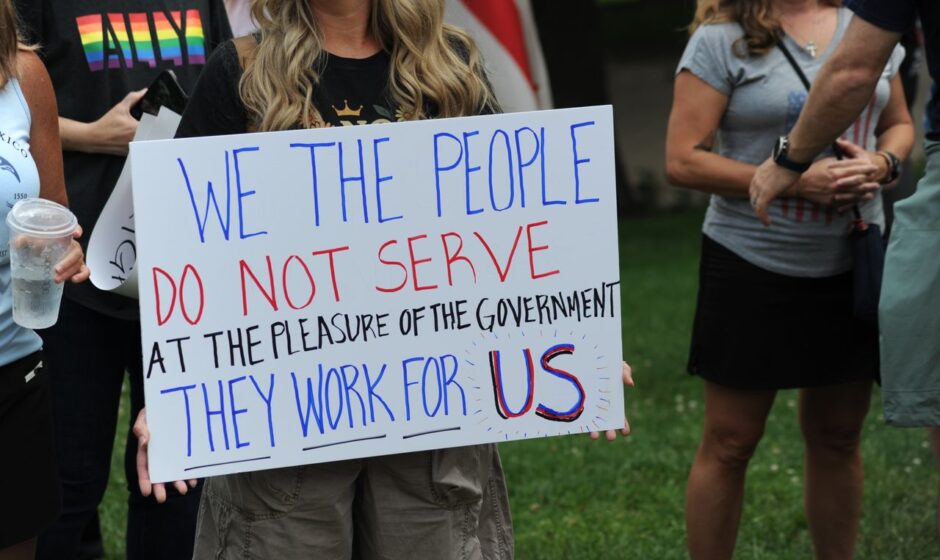
Democratic socialism is often presented in American political debate as a frightening word, conjuring images of government control, authoritarian dictators and a society in which individuality disappears. But there is another way to understand the idea — one rooted less in political labels and more in the fundamental human need for community. Photo by Germar Derron
Three words at the beginning of the U.S. Constitution offer a useful place to start— We the People. Those words are not a declaration of individual isolation. They are a declaration of collective self-determination. The United States was created as a nation of people who would govern themselves together. The individual mattered, but the individual was not the entire premise.
The we is the foundation for the I. Human beings have never been truly solitary creatures. We survive, learn and prosper through cooperation. Families care for children. Communities care for people in need. Workers build things together. Farmers, engineers, teachers, doctors, builders and countless others contribute pieces to a society that no individual could create alone.
Even the person who prides themselves on being completely self-reliant is surrounded by the work of other people. The road they drive on was built collectively. The electrical grid powering their home was built through generations of collective investment. The communications networks connecting them to the world are the products of enormous cooperation. The schools that educated them, the legal institutions that protect their property and contracts, the emergency services that respond when they need help and the medical system that can save their life all exist because people decided that some things are better accomplished together.
That doesn’t diminish individual achievement. It makes individual achievement possible. This is where the concept of democratic socialism can be understood differently from the caricature that frequently dominates American political rhetoric.
At its most basic philosophical level, socialism can be understood as an emphasis on the social — on community, cooperation and shared responsibility. Democratic socialism adds democratic self-determination to that idea: People collectively decide how their society should function, while individuals retain the freedom to pursue their own lives.
That does not require everyone to look alike, think alike or live alike. Quite the opposite. A strong community can give individuals more freedom to be different because the community provides a foundation from which individuals can take risks.
A person who knows that a medical emergency will not destroy their family financially has greater freedom to pursue an education, start a business or change careers. A person who has access to education has greater freedom to develop their abilities. A society with functioning infrastructure gives people opportunities that would be impossible if every individual had to build their own roads, power plants, water systems and communications networks.
Collective strength can therefore expand individual freedom rather than diminish it. The distinction is important because American political arguments frequently treat the we and the I as opposing forces. They don’t have to be.
The WE is the foundation for the I.
A child does not become independent because nobody helps them. A child becomes independent because other people help them enough to develop the ability to stand on their own.
Civilization works in much the same way. We build the road, and the individual gets to decide where to drive. We build the school, and the individual gets to decide what to learn. We create the infrastructure, and the individual gets to decide what to create.
We establish democratic institutions, and the individual gets a voice in determining the nation’s direction. The community provides the foundation. The individual determines what to build upon it. That is not the destruction of individuality. It is the environment in which individuality can flourish.
America has always contained this tension between individualism and collective responsibility. The nation’s economic system is capitalist, and the Constitution strongly protects individual rights and property. It would therefore be historically inaccurate to simply declare that the Founders were democratic socialists in the modern political sense.
But America is also undeniably a society built through collective action. The Constitution itself begins with a collective assertion of authority: “We the People.” It establishes a government intended to serve the nation as a whole and explicitly identifies promoting the general welfare among one of the purposes of our federal government.
The argument over what “general welfare” requires is a legitimate political debate. But the underlying principle is difficult to miss — A nation is not merely a collection of isolated individuals competing against one another. A nation is a people. That distinction becomes especially important when considering health care.
In the United States, political arguments sometimes emphasize the importance of being able to “choose your own doctor.” But choice only means something when a person has meaningful access to healthcare in the first place. A person without health coverage may technically have the freedom to choose a doctor while lacking the financial ability to see any doctor at all.
The larger question is therefore not simply whether Americans should have choices. It is whether a wealthy, technologically advanced nation has a responsibility to ensure that its people can actually participate in the systems that sustain their lives.
A community that can collectively provide health care, education, infrastructure and public safety has choices about whether and how to do so. Those choices are political. But describing every form of collective provision as an assault on individual freedom ignores how much individual freedom already depends upon collective institutions.
The same principle applies to economic life. Capitalism can produce innovation, entrepreneurship and extraordinary individual achievement. But capitalism is not synonymous with democracy, and wealth is not synonymous with virtue. When money becomes sufficiently powerful to dominate political institutions, the democratic relationship between citizens and government can be distorted.
The danger isn’t simply that someone becomes wealthy. The danger is when the I becomes so powerful that it begins to overwhelm the we. The purpose of democratic government should not be to eliminate individual ambition. It should be to create a society in which individual ambition doesn’t require the exploitation or abandonment of everyone else.
A successful society should allow people to become wealthy. It should also allow people who aren’t wealthy to live with dignity. It should encourage invention without allowing the inventor to own the entire society. It should reward hard work without pretending that success occurs without a foundation built by millions of other people.
It should protect individual freedom while recognizing that freedom itself depends upon functioning institutions. And perhaps most importantly, it should understand that cooperation does not mean conformity. The fear that socialism means everyone must become identical misses the distinction between collective responsibility and collective identity. We don’t have to be the same to help one another.
A community can contain conservatives and liberals, believers and nonbelievers, entrepreneurs and employees, artists and engineers, wealthy people and poor people, introverts and extroverts, traditionalists and radicals. Democratic society doesn’t require everyone to want the same life. It requires us to agree that everyone belongs to the same society.
That is the power of We the People. The we doesn’t erase the I. The we makes the I possible.
Every generation inherits a foundation built by previous generations and then adds something of its own. The roads, schools, hospitals, scientific discoveries, technologies, institutions and cultural achievements of one generation become the platform upon which the next generation builds.
That is the great bargain of civilization. We contribute something to the whole, and the whole gives us possibilities that we could never create alone. One person can have an idea. Millions of people can create the conditions that allow that idea to become reality.
One person can dream. A society can give that person the opportunity to pursue the dream. One person can become extraordinary. But behind every extraordinary individual stands an extraordinary number of ordinary people whose collective contributions made that achievement possible. That is not a weakness of individualism, it’s the truth behind it.
So perhaps democratic socialism does not need to be explained through the political boogeyman Americans have been taught to fear. Perhaps, at its most basic level, it can be explained through something much simpler: We the People.
We are stronger together than we are alone. We protect one another so that individuals can go farther. We build together so individuals can create. We contribute to the whole so that each person has a greater opportunity to determine their own destiny. The we is not the enemy of the I. The WE is the foundation for the I. And perhaps that is one of the most fundamentally democratic ideas America has ever expressed.