
Galactday: 56747.4
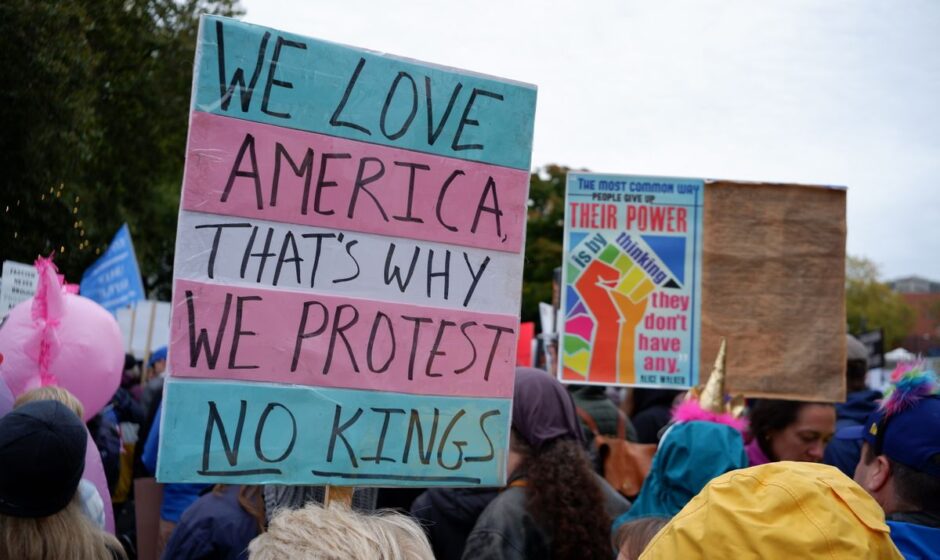
There’s something deeply American about a democracy that refuses to be quiet. We argue. We protest. We organize. We complain. We write letters, make phone calls, publish newspapers, post on social media, march in the streets and stand outside our government buildings demanding that those in power listen. Sometimes it is chaotic. Sometimes it is frustrating. Sometimes it is downright loud. And yet, that noise may be one of the most important signs that American democracy is still functioning. Photo by Rufina Rusakova
I’ve often said, “We the People are the check when the balance fails.” The phrase is not meant to suggest that citizens replace the institutions established by our Constitution. Congress, the courts, state governments, elections, the press and other institutions all have defined roles in limiting government power.
But institutions are operated by people. They can become weakened. They can become intimidated. They can become captured by political interests. And when the machinery designed to check power begins to malfunction, citizens cannot simply assume someone else will fix it. That is where We the People comes in.
The opening words of our Constitution are not We the Government. They are not We the President. They are not We the Congress. They are “We the People.” That matters. The American experiment was built around the idea that governmental authority ultimately comes from the people. Those who hold public office are entrusted with power; they do not own it.
That distinction becomes especially important whenever a political leader begins behaving as though the office itself is the source of authority rather than the institution through which the public temporarily exercises its authority.
History offers plenty of warnings about what happens when political systems become increasingly centered on one person, when dissent becomes disloyalty and when leaders begin surrounding themselves with people whose primary qualification is loyalty rather than their willingness to provide unwelcome information.
An illiberal government can become so obsessed with eliminating perceived enemies that it eventually eliminates people who know how the government actually works. That is one of the dangers of concentrated power. Eventually, people stop telling those at the top what they need to hear and start telling them what they believe they want to hear.
Democracy was designed to make that much harder. It is inherently messy because millions of people are not supposed to think alike. Americans are not supposed to receive their political opinions from one authority and repeat them in unison. We are supposed to disagree. We are supposed to challenge our leaders. We are supposed to question government decisions. We are supposed to organize when we believe something is wrong.
That doesn’t mean every protest is correct or every political movement is justified. Democracy does not guarantee that citizens will always be right. It guarantees something more fundamental: citizens have the right to participate in deciding what happens next.
That is why peaceful protest matters. When millions of people take to the streets, they are not necessarily attempting to overthrow the government. People may simply be exercising one of the oldest democratic rights available to us: telling our government that we disagree.
And when people can still speak publicly, organize, assemble and demand accountability, those activities themselves demonstrate that the public has not surrendered its political agency. That is why I believe American democracy can be described as loud, chaotic and harmonious at the same time.
The contradiction is only apparent. A democracy can be loud because people are free to disagree. It can be chaotic because millions of independent citizens cannot be expected to move like a military formation. And it can be harmonious because all of those competing voices can still participate within a common political framework.
That’s the strength of America, our voices. Harmony does not mean everyone sings the same note. Sometimes harmony is what happens when different notes are allowed to exist together.
America has always had a rebellious streak. The country’s founding itself emerged from a dispute over who had the authority to govern whom and under what terms. The American political tradition has repeatedly produced citizens willing to challenge institutions, leaders and established assumptions. That rebelliousness can be dangerous when it becomes violent or rejects democratic institutions altogether. Inciting insurrection is never patriotism, it’s just criminal.
But peaceful civic rebellion — the willingness to say no, to question authority and to demand that government justify its actions — can be one of democracy’s greatest safeguards.
No president, regardless of party, owns America. No political party owns America. No government official owns America. The country belongs to its citizens. That doesn’t mean citizens get everything they want. Democracy is not a machine for turning every public demand into government policy. Other citizens have rights, too. Constitutional limits exist precisely because majority power can also become abusive.
But it does mean that Americans retain something enormously important: the ability to participate in the argument. As long as we can speak, we are participating. As long as we can organize, we are participating. As long as we can assemble peacefully, we are participating. As long as we can vote, challenge government decisions in court, investigate those in power and demand accountability from elected officials, We the People remain part of the system that gives government its legitimacy.
And perhaps that is the most important lesson. Democracy does not survive because everyone agrees that it is working perfectly. It survives because enough people believe it is worth participating in — especially when they believe it is failing. The greatest check on political power may therefore not be a single institution. It may be the collective determination of millions of citizens who refuse to become silent.
We the People are not spectators to American democracy. Americans are part of its machinery. And when the machinery begins to fail, the people still have a voice. That voice may be loud. It may be chaotic. It may be angry. It may be hopeful. It may come from millions of different directions at once. But if the people are still speaking, organizing and demanding to be heard, the democratic conversation has not ended. It is still America. And the argument is still ours.