
Galactday: 56501.0
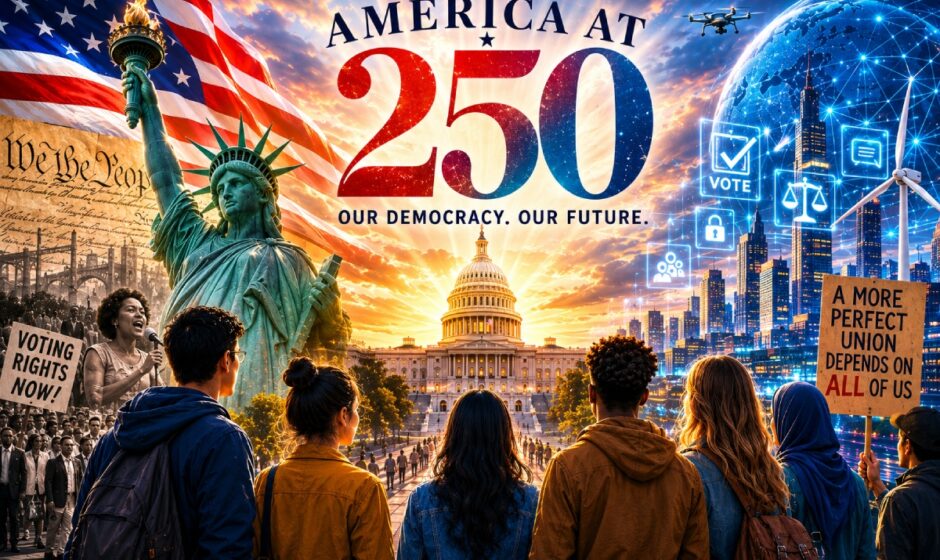
As the United States celebrates its 250th anniversary, Americans find themselves standing at a crossroads unlike any faced by previous generations. Our nation was born from a revolutionary idea—that ordinary people could govern themselves and that legitimacy flowed not from kings or inherited privilege, but from the consent of the governed. Two and a half centuries later, that idea remains both powerful and unfinished. Photo by awf
Anniversaries often invite nostalgia. They encourage citizens to look backward, celebrating triumphs and honoring traditions. Yet America’s semiquincentennial arrives at a moment when looking forward may be more important than looking back. The country is entering an era defined by artificial intelligence, global connectivity, demographic change, and a generation that increasingly questions assumptions inherited from the twentieth century.
The challenge facing the United States is not whether it can preserve the past exactly as it was. The challenge is whether it can preserve the democratic principles that made progress possible in the first place.
American democracy has never been a completed project. Throughout our nation’s history, its promises have expanded through struggle, debate, and civic participation. Voting rights, civil rights, labor protections, equal opportunity, and broader representation emerged not because history moved inevitably toward justice, but because citizens demanded that the nation live up to its own ideals.
The 250th anniversary therefore represents more than a celebration of national longevity. It serves as a test of whether Americans remain committed to the difficult work of self-government.
That question became especially urgent in the aftermath of January 6, 2021.
The attack on the Capitol left a scar that extends beyond the damage inflicted on a building. It challenged assumptions many Americans held about the resilience of democratic norms and institutions. For generations, peaceful transfers of power had been viewed as a settled feature of American political life. Suddenly, millions were confronted with the reality that democratic systems are not self-sustaining. They depend on citizens, leaders, institutions, and shared commitments that must be continually renewed.
Yet the lasting lesson of that day is not simply one of vulnerability. It is also one of endurance.
The constitutional process continued. Election results were certified. Courts functioned. Institutions held under extraordinary pressure. Democracy survived not because it was immune to challenge, but because enough people remained committed to protecting it.
As significant as those events were, they may ultimately be remembered as part of a larger transition already underway.
The twentieth century shaped much of modern America. It was an era defined by industrial power, mass media, national television networks, and institutions that served as gatekeepers of information. Citizens largely consumed news from a handful of sources, participated in political life through established channels, and viewed the world through frameworks shaped by the Cold War and the nation-state.
The twenty-first century has disrupted nearly all of those assumptions.
Information moves instantaneously across continents. Social media platforms allow individuals to reach audiences once accessible only to major media organizations. Artificial intelligence is beginning to transform how information is created, distributed, and consumed. Traditional institutions increasingly find themselves competing with decentralized networks and digital communities for public trust and attention.
For younger generations, these realities are not new developments. They are simply the world as they have always known it. As a result, many younger Americans approach democracy differently than their predecessors. They tend to expect greater transparency, faster communication, and more direct forms of participation. They are often skeptical of institutions but deeply invested in issues ranging from climate change and economic opportunity to digital privacy and social justice.
Their political identity is also shaped by unprecedented global interconnectedness. Previous generations could reasonably view international events as distant concerns. Today’s citizens understand that pandemics, cybersecurity threats, climate disruptions, economic shocks, and technological breakthroughs rarely respect national borders. The world has become too interconnected for isolation to serve as a long-term strategy.
This does not mean abandoning national interests or national identity. It means recognizing that effective leadership increasingly requires cooperation alongside competition. The defining debates of the coming decades will center on how democratic societies navigate that balance while preserving their sovereignty and values.
Technology will play a central role in that effort. If voting defined the great democratic battles of earlier centuries, information may define the next one. The ability to distinguish fact from manipulation, evidence from propaganda, and truth from fiction will become essential civic skills. The future of democracy may depend as much on digital literacy as it does on traditional political participation.
Artificial intelligence, algorithmic influence, privacy rights, and the concentration of digital power will force societies to confront questions that previous generations never had to answer. How those questions are resolved may shape the character of democratic governance for decades to come.
As America enters its next quarter millennium, the nation has an opportunity to embrace a more mature understanding of patriotism. Patriotism is not unquestioning loyalty to political leaders, parties, or movements. It is a commitment to the principles that allow free societies to endure. It is the belief that democracy is strengthened through participation, accountability, and civic engagement.
The United States has never been defined by perfection. It has been defined by the ongoing pursuit of a more perfect union —that pursuit remains unfinished.
The America that celebrates its 250th anniversary is not the America of 1776, nor should it be. Every generation inherits the republic and leaves its mark upon it. The task before today’s Americans is not to recreate the past, but to ensure that the democratic values that survived revolution, civil war, economic upheaval, and political crisis remain strong enough to guide the nation through the challenges ahead.
The scar left by January 6 will remain part of that story. So too will the technological revolutions, social transformations, and generational shifts that define the present era. Together they mark the end of one chapter and the beginning of another.
At 250 years old, American democracy is neither finished nor fading. It is evolving. The question that will define the next century is whether citizens are willing to shape that evolution with the same courage, imagination, and commitment that built the republic in the first place.