
Galactday: 56123.2
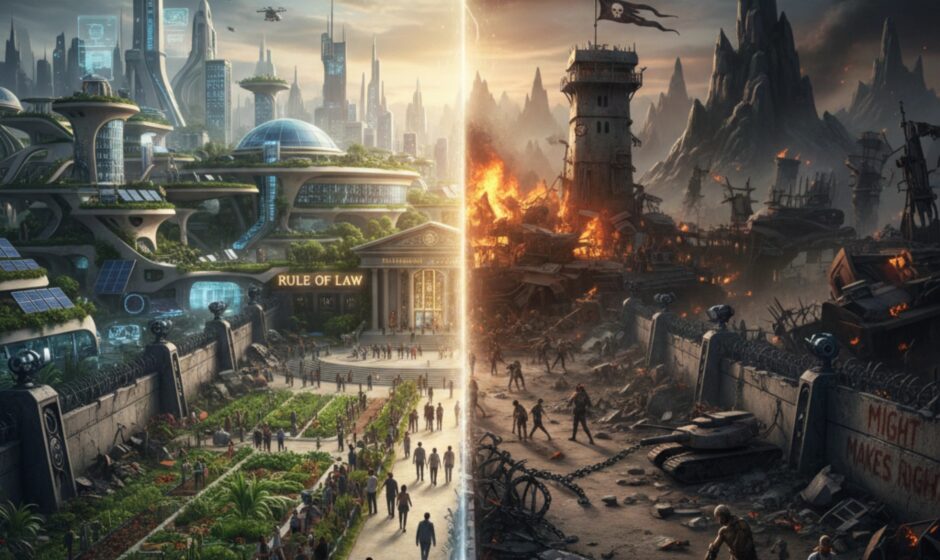
The human imagination has long been captivated by the vision of Utopia – a perfect society, free from strife, injustice, and want. Yet, history and philosophy consistently remind us that such an ideal comes with a steep price, a constant vigilance against the forces that would unravel its delicate fabric. The fundamental differences between cooperative and brute-force societies, arguing that while the former builds a sustainable future on trust and verifiable facts, the latter inevitably consumes itself in a spiral of chaos, offering only a fleeting illusion of strength. Photo by AWF
The very qualities that make a Utopia desirable – its peace, prosperity, and openness – are precisely what make it a tempting target for those who operate by the sword, creating a paradox that dictates the ongoing struggle for a just world.
The foundation of civilization is cooperation and the Rule of Law. At the heart of any truly just and thriving society lies the principle of cooperation. This is not merely a feel-good sentiment; it is a fundamental evolutionary and sociological strategy that maximizes collective well-being. When individuals choose to cooperate, they implicitly agree to a social contract, trading absolute, unfettered autonomy for the immense benefits of collective security, shared resources, and cumulative progress. This agreement manifests most tangibly in the Rule of Law.
The Rule of Law is the predictability engine of civilization. It establishes transparent, universally applicable standards of conduct, ensuring that justice is blind and impartial. In a society governed by law, individuals can invest their time and energy into productive endeavors – cultivating fields, developing technologies, or creating art – without the constant, draining fear of arbitrary violence or theft. Knowing that one’s property is protected, that agreements will be honored, and that disputes will be settled fairly fosters an environment of high trust. This trust, in turn, lubricates the gears of complex economic systems, allowing for credit, long-term investments, and the specialization of labor that drives innovation.+1
Furthermore, a cooperative society, by its very nature, tends towards distributed power structures, typically manifesting as a democracy or republic. Such systems are designed to prevent the concentration of power in any single entity, safeguarding against tyranny and ensuring that the needs and voices of the populace are heard. It is within such frameworks that institutions of learning, scientific inquiry, and open debate flourish, becoming crucibles for the generation and verification of facts. Truth, in this context, is not a political tool but a shared pursuit, essential for effective problem-solving and collective advancement. When decisions are based on evidence and consensus, rather than dogma or brute decree, the society gains a profound adaptive advantage.
The Quicksand of Power is the Brute-Force Society. In stark contrast stands the society built upon brute force, violence, and chaos. This is less a “society” in the constructive sense and more a predatory hierarchy, an unstable edifice erected on the shifting sands of fear. In such a realm, the concept of a social contract is alien; power is seized through intimidation and maintained through constant displays of aggression.
The structure of a brute-force society invariably defaults to autocracy or warlordism. Leadership is a precarious position, held only by the strongest, most ruthless individual until a challenger emerges to violently depose them. The “glue” that binds such a group together is not trust or shared values, but fear. Cooperation, if it exists at all, is enforced through coercion, temporary and fragile, dissolving the moment the enforcer’s gaze shifts.
The social fabric is defined by low trust. Every individual is a potential competitor, every interaction a latent threat. This pervasive paranoia imposes a crippling “Paranoia Tax” on the entire group. Enormous resources, both human and material, are diverted from productive activity into internal defense, surveillance, and the suppression of dissent. There is no incentive for long-term planning, no security for investment, and certainly no safe space for the slow, meticulous work of scientific discovery or artistic creation. Knowledge is hoarded or destroyed, twisted into propaganda to maintain the ruler’s power, or simply lost in the frequent, violent turnovers of leadership. In such a system, facts are inconvenient obstacles, readily dismissed or fabricated to suit the whims of those in power, further eroding any possibility of collective learning or progress.
The Inevitable Chasm is Technological and Intellectual Divergence. The stark differences in societal foundations lead to an inevitable divergence in technological and intellectual capabilities. The cooperative society excels through specialization. A physicist can dedicate a lifetime to understanding the universe, confident that others are growing food, building infrastructure, and maintaining peace. This division of labor, supported by a vast network of trust, allows for monumental projects, complex research, and rapid innovation. Knowledge compounds, passed down through institutions and archives, allowing each generation to build upon the triumphs of the last.
The brute-force society, conversely, faces an innovation ceiling. Every individual must be a generalist survivor, constantly vigilant, always ready to fight. There is no luxury for deep specialization. A brilliant inventor in such a society might devise a groundbreaking concept, but who will fund its development, protect its components, or ensure its distribution?
The “brain drain” is constant; those with true intellectual capacity either flee to more stable societies or find their talents suppressed or exploited for immediate, violent ends. While they might be able to pillage existing technologies, they rarely possess the stability, the trust networks, or the foundational scientific understanding to replicate or advance them. A warlord can steal a drone, but cannot build the microchip factory or maintain the global satellite network necessary for its operation.
Ultimately, a predatory society is limited by its inherent instability and lack of cumulative knowledge. It cannot sustain complex, long-term endeavors requiring widespread collaboration. It reaches a “complexity ceiling,” where the sheer demands of internal control and conflict overwhelm any potential for genuine progress.
The Price of Utopia is Vulnerability and the Paradox of Defense. The tragic irony of a utopian society is that it’s very virtues — its peace, prosperity, and openness — make it an attractive target for external forces operating under a brute-force paradigm. The “Golden Goose Paradox” dictates that an invader, driven by avarice, seeks to “take over” the harmonious society, only to destroy the very engine of its value.
By imposing a regime of fear and exploitation, the conqueror invariably dismantles the trust networks, stifles innovation, and drives away or suppresses the intellectual capital that generated the wealth in the first place. The “price” of Utopia, then, is its inherent vulnerability to those who do not understand or value the principles upon which it is built.
This leads to the “Tolerance Paradox”: for a harmonious society to survive, it must sometimes resort to force to defend itself. Does building a formidable military, developing robust cybersecurity, or enforcing strong borders dilute its Utopian ideals? The answer, many argue, lies in the intent and the continuous commitment to its foundational principles. A cooperative society might become “armed,” but it does not become “predatory” so long as its use of force remains defensive, bound by the Rule of Law, and aimed at restoring peace rather than imposing dominion.
The Enduring Imperative of trust and facts. The extinction of the brute-force society, while often protracted and bloody, appears almost inevitable through a process of self-consumption. Its internal conflicts, lack of innovation, and inability to sustain long-term goals lead to an ultimate collapse. The Price of Utopia, therefore, is an unceasing commitment to its core tenets: the cultivation of trust as the bedrock of social interaction, and the unwavering pursuit of facts as the guide for collective action.
A truly just society is not merely an absence of conflict, but a dynamic, self-correcting system that champions cooperation, defends truth, and understands that its greatest strength lies not in the sword, but in the shared bonds of its people and their collective wisdom. The dream of Utopia, while perhaps never fully realized, remains an essential beacon, reminding us of the profound value of the society we strive to build and the vigilance required to protect it.